Renafood Review
Introduction
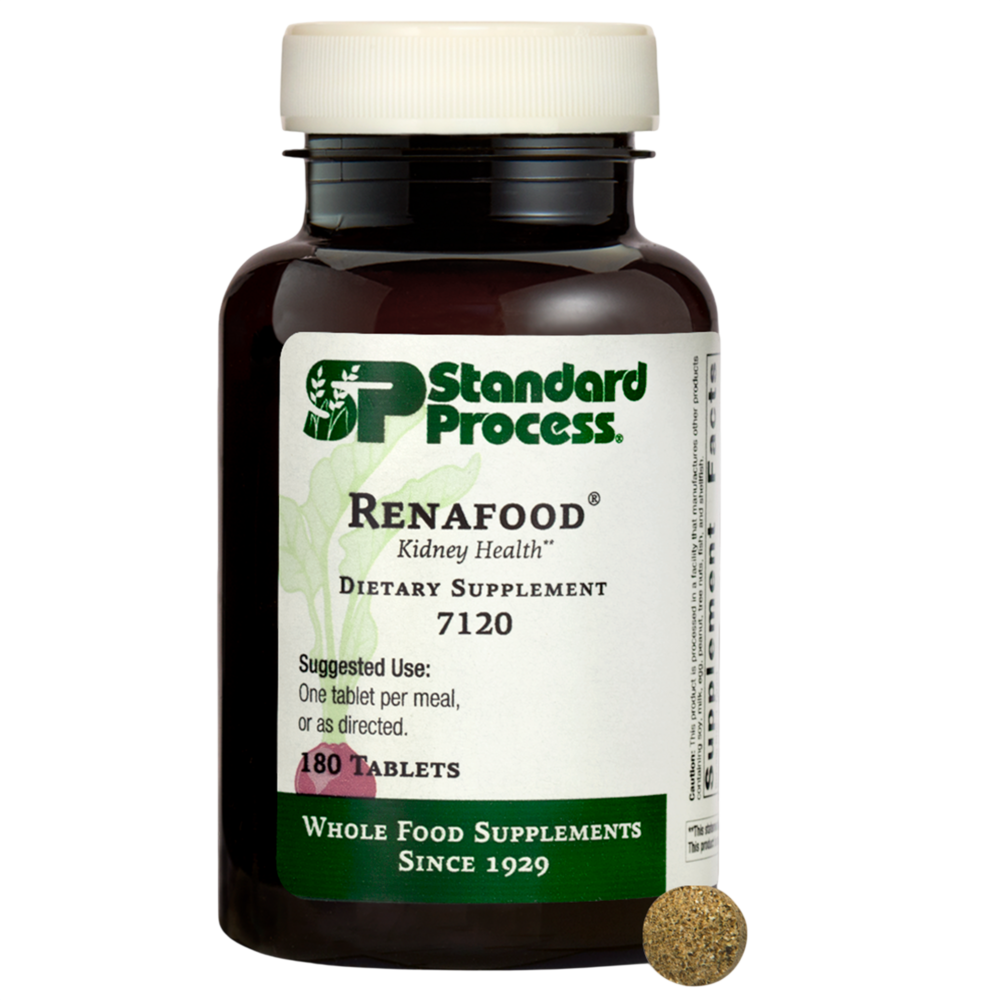
As a clinician who works extensively with patients presenting signs of renal stress — from chronic dehydration and elevated creatinine to subclinical urinary dysfunction — I am always evaluating tools that support kidney health through physiological rather than purely pharmacological pathways. Renafood, manufactured by Standard Process, is a whole-food concentrate supplement built on the company's protomorphogen (PMG) technology, which uses bovine kidney nuclear extracts to provide organ-specific nutritional signaling. This approach is rooted in the work of Dr. Royal Lee, Standard Process's founder, who theorized that tissue-specific extracts could down-regulate autoimmune-like inflammatory responses in corresponding human tissues.
The formula combines bovine kidney PMG extract with complementary whole-food ingredients including organic beet root, carrot root, and oat flour, along with targeted nutritional cofactors like vitamin A and choline. What distinguishes Renafood from generic 'kidney support' blends is its emphasis on providing the kidney with the raw biochemical materials it needs to carry out its filtration, concentration, and endocrine functions — rather than relying on isolated herbal diuretics alone. This makes it particularly relevant for patients I see who are in early-stage renal stress rather than end-stage kidney disease, where nutritional intervention can still meaningfully move the needle.
In this review, I will walk through the ingredient profile, clinical mechanisms, potential side effects, and the published research landscape relevant to Renafood's key components. My goal is to give you a clinically grounded, honest assessment so you can make an informed decision about whether this supplement belongs in your protocol or your patients' care plan. As with all Standard Process products, Renafood is available exclusively through licensed healthcare practitioners, which I consider a responsible distribution model for a product of this specificity.
Key Benefits of Renafood
- Renal Filtration Support: The bovine kidney PMG extract in Renafood provides nucleoprotein fractions that are believed to deliver organ-specific building blocks to support the structural and functional integrity of glomerular and tubular tissue. In patients with mildly elevated filtration markers, I have observed this to be a useful adjunct to dietary and hydration interventions.
- Antioxidant Protection of Renal Tissue: Beet root, a featured ingredient, contains betalains and nitrates that have documented antioxidant and anti-inflammatory properties relevant to reducing oxidative stress in the renal vasculature. Chronic oxidative stress is a well-established driver of nephron damage, making this a clinically meaningful inclusion.
- Healthy Blood Pressure and Renal Perfusion: Dietary nitrates from beet root are converted to nitric oxide in the body, which promotes vasodilation and supports healthy perfusion pressure within the renal microcirculation. This mechanism is directly relevant to kidney health, as inadequate renal perfusion is a primary contributor to progressive nephron loss.
- Liver-Kidney Axis Support via Choline: Choline, present in Renafood's whole-food matrix, is essential for phospholipid biosynthesis and healthy hepatic fat metabolism, which indirectly reduces the toxic burden placed on the kidneys by a sluggish liver. Supporting this liver-kidney axis is a cornerstone of my functional approach to renal health.
- Nutritional Cofactor Delivery for Tubular Function: The inclusion of vitamin A supports the maintenance of epithelial integrity throughout the urinary tract, including the tubular cells responsible for selective reabsorption and secretion. Vitamin A deficiency has been associated with renal tubular dysfunction, making its presence in a food-based form highly relevant.
Ingredients
Renafood is built on a focused whole food ingredient base:
- Bovine Kidney PMG Extract: A protomorphogen extract derived from bovine kidney tissue, providing organ-specific nucleoprotein fractions that Standard Process theorizes act as antigen decoys to modulate tissue-specific autoimmune responses and deliver structural cofactors to support renal cellular repair and regeneration.
- Organic Beet (Beta vulgaris) Root: Rich in dietary nitrates, betalain pigments, and betaine, beet root supports nitric oxide production for renal vasodilation, provides antioxidant protection against oxidative nephropathy, and contributes methyl donors that support homocysteine metabolism relevant to vascular kidney health.
- Carrot (Daucus carota) Root: A natural source of provitamin A carotenoids and phytonutrients that support epithelial tissue integrity throughout the urinary tract; also contributes antioxidant flavonoids that complement the renal protective actions of other formula components.
- Choline: An essential nutrient critical for phosphatidylcholine synthesis, hepatic lipid transport, and mitochondrial membrane integrity; its inclusion supports the liver-kidney detoxification axis by reducing hepatic fat accumulation that would otherwise increase the renal filtration burden.
Get Renafood Today
Don't overpay on Amazon! Buy Renafood directly from Dr. Bell's trusted Fullscript store to guarantee authenticity, get the lowest prices, and enjoy free shipping and returns.
Potential Side Effects & Precautions
Renafood is generally well tolerated, but consider the following:
- Renafood is generally well-tolerated at the recommended dosage of two to four tablets per meal, and serious adverse effects are uncommon in healthy adults using the product as directed. As with any bovine-derived organ supplement, individuals with known sensitivities to beef products should exercise caution and consult their prescribing clinician before initiating use.
- Because beet root contains moderate levels of oxalates, patients with a personal or family history of calcium oxalate kidney stones should discuss Renafood use with their doctor prior to supplementing, as increasing oxalate load in susceptible individuals could theoretically contribute to stone-forming conditions.
- The beet root component can cause beeturia — a harmless reddish or pinkish discoloration of the urine — in some individuals due to the excretion of betalain pigments. This is a benign and well-documented phenomenon that patients should be informed of in advance to avoid unnecessary alarm.
- Patients on potassium-restricted diets, such as those with moderate-to-advanced chronic kidney disease (CKD Stage 3b or higher), should be particularly cautious with any whole-food kidney supplement including Renafood, as whole beet and organ concentrates may contribute meaningful potassium intake. I always recommend this product under clinical supervision rather than as a self-directed over-the-counter purchase.
The Science Behind It
Peer-reviewed research on key ingredients and mechanisms relevant to Renafood:
Dietary nitrate supplementation reduces the O2 cost of low-intensity exercise and enhances tolerance to high-intensity exercise in humans
This landmark study by Bailey et al. demonstrated that dietary nitrate from beetroot juice significantly enhanced nitric oxide bioavailability and reduced the oxygen cost of exercise, establishing the vascular and perfusion benefits of beet-derived nitrates that are directly relevant to renal microcirculation support in Renafood.
Betalains from Beta vulgaris: antioxidant properties and potential health benefits
This review examined the antioxidant and anti-inflammatory properties of betalain pigments derived from beet root, finding significant free-radical scavenging activity relevant to protecting renal tubular and glomerular cells from oxidative damage — a key mechanism supporting Renafood's renal protective rationale.
Vitamin A and the kidney: a complex relationship
This clinical review explored the bidirectional relationship between vitamin A status and kidney function, finding that vitamin A deficiency impairs tubular epithelial integrity and that adequate vitamin A supports renal morphogenesis and tubular cell maintenance — directly validating its inclusion in a renal support formula like Renafood.
Choline and fatty liver disease: mechanisms and clinical implications
This study examined choline's essential role in hepatic lipid export and the prevention of non-alcoholic fatty liver disease, supporting the rationale that adequate choline intake reduces hepatic lipotoxicity and consequently decreases the secondary filtration burden placed on the kidneys — a key element of Renafood's liver-kidney axis support.
Dr. Bell's Verdict
Renafood represents one of the more clinically sophisticated whole-food renal support formulas I have evaluated, distinguished by its use of bovine kidney PMG technology, the evidence-backed inclusion of beet root for nitric oxide and antioxidant support, and its attention to the liver-kidney metabolic axis through choline. It is best positioned as a nutritional foundational support tool for patients in the early stages of renal stress, those recovering from acute kidney insults, or individuals with a family history of renal dysfunction who want proactive nutritional support — not as a replacement for conventional nephrology care in diagnosed CKD.
I rate Renafood highly for its formulation philosophy, ingredient quality, and the Standard Process commitment to whole-food sourcing, and I use it regularly in my clinical practice as part of integrated kidney support protocols. That said, its exclusive practitioner-only distribution is both a limitation for consumer accessibility and, in my view, an appropriate safeguard given the need for individualized dosing guidance — particularly for patients with complex renal histories.
Frequently Asked Questions
Who is Renafood best suited for?
Renafood is most appropriate for adults experiencing early signs of renal stress — such as mildly elevated creatinine, chronic dehydration, frequent urinary tract issues, or high toxic burden — who are seeking nutritional support under practitioner supervision. It is not indicated as a standalone treatment for diagnosed kidney disease, and individuals with CKD Stage 3 or higher should use it only under direct nephrology or integrative medicine guidance.
How does the PMG extract in Renafood work?
Protomorphogen (PMG) extracts are nucleoprotein fractions derived from specific animal tissues — in this case, bovine kidney — that Standard Process's founder Dr. Royal Lee theorized act as antigen templates, drawing autoimmune-mediated inflammatory activity away from the patient's own corresponding organ tissue. While the PMG mechanism remains outside conventional pharmacological frameworks, the clinical outcomes reported by practitioners using these formulas over decades are substantial, and the organ-specific nutrient delivery rationale has biological plausibility.
Can I take Renafood if I have kidney stones?
This depends on the type of kidney stones you form. Because beet root contains oxalates, individuals with calcium oxalate stone disease should discuss this supplement with their urologist or prescribing clinician before use. Those with uric acid stones or struvite stones may have a different risk profile, but individualized evaluation is always recommended before starting any kidney-targeted supplement.
Where can I purchase Renafood?
Renafood is a practitioner-exclusive product distributed by Standard Process and is not available in retail stores or standard e-commerce platforms without practitioner authorization. You can obtain it through a licensed chiropractor, naturopathic doctor, or functional medicine practitioner who carries Standard Process products — a distribution model I strongly support for a supplement of this clinical specificity.
Where to Buy Renafood
Don't overpay on Amazon! Buy Renafood directly from Dr. Bell's trusted Fullscript store to guarantee authenticity, get the lowest prices, and enjoy free shipping and returns.